Is the Waste-to-Energy (WtE) Project a Momentum for Improving Waste Management Systems?
Source: Bisnis.com | January 5, 2025
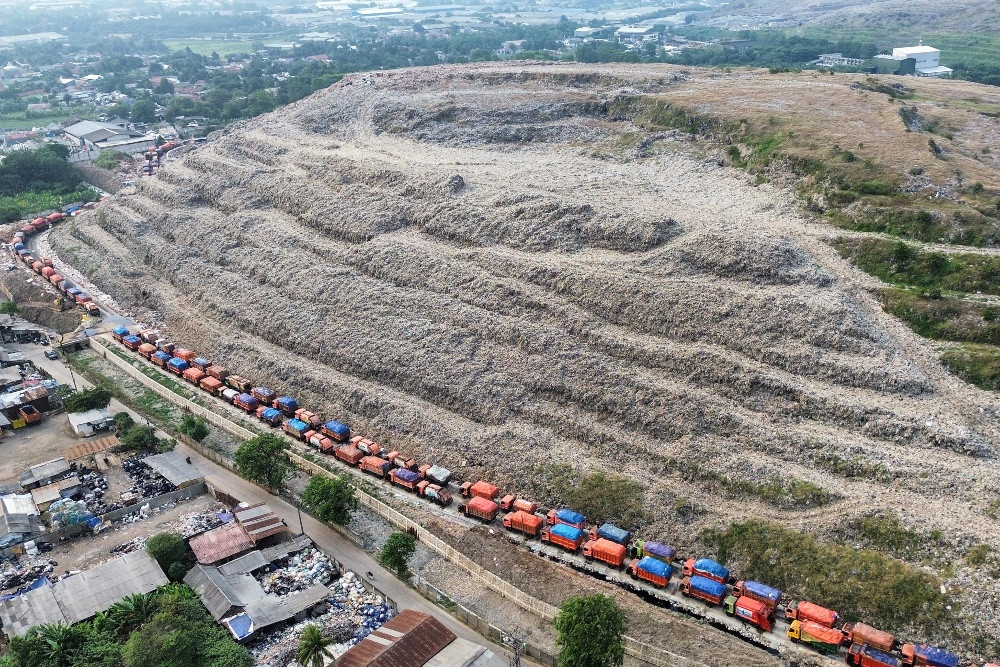
The government’s goal of eliminating the piles of waste at Integrated Waste Processing Sites (TPST) through waste-to-energy (WtE) projects cannot be a standalone technical solution, but rather is supported by improvements to the comprehensive waste management system.
Sekti Mulatsih, WWF Indonesia’s Plastic Smart Cities Program Manager, supports the government’s efforts to find waste management solutions. However, she believes that WtE technology must be implemented with careful planning and the selection of technology that is appropriate to the characteristics of waste in Indonesia.
This is in response to a statement by Coordinating Minister for Food Affairs Zulkifli Hasan, who projected that the Bantar Gebang TPST waste would be “eradicated” within the next two years.
“As a tropical country with high rainfall, the two factors that most determine the chemical characteristics of urban waste in Indonesia are the high bioorganic fraction and high moisture content,” Sekti explained to Bisnis on Friday (12/19/2025).
According to Sekti, with organic waste still dominant in many cities, thermal treatment of WtE will be very different from waste in temperate countries.
Currently, he continued, there are still many types of waste that can be managed with cheaper and more environmentally friendly technologies before entering the incineration stage. Therefore, the key to WtE’s success lies in waste segregation at the source.
“In a country with waste characteristics like Indonesia, WtE cannot stand alone as a purely technical solution. It must be supported by comprehensive system improvements, from household-level sorting and strengthening the collection chain, intermediate facilities, to controlling emissions and residues downstream,” he explained.
Without these system improvements, WtE risks becoming expensive, inefficient, and creating new, potentially more harmful environmental impacts.
Conversely, if sorting is carried out effectively and material flows are designed according to the characteristics of the waste, WtE can function as part of a more environmentally friendly circular economy, reducing the burden on landfills (TPA), and being a financially viable solution.
Circular Economy
Furthermore, Sekti stated that WWF-Indonesia recommends implementing circular economy principles in comprehensive waste management. This principle prioritizes reducing waste generation upstream, through changes in more responsible consumption and production behavior.
“This effort is followed by waste sorting at the source to ensure valuable materials can be reused and organic fractions are properly managed, thereby minimizing pollution and resource loss,” he said.
At the downstream stage, he encouraged environmentally friendly final processing through recycling, organic processing, and selective energy utilization, while prioritizing emission and residue control.
Previously, Coordinating Minister for Food Affairs Zulkifli Hasan (Zulhas) targeted the elimination of waste at the Bantargebang Integrated Waste Processing Site (TPST) in Bekasi, West Java, within the next two years.
This target is expected to be achieved in line with Danantara’s strategic project, which will invest in a waste-to-energy (WTE) program.
According to Zulhas, waste processing using WTE technology will be the solution to the problem of urban waste that has been piling up in several areas. “So, God willing, Bantargebang will be gone in two years, and in two years, Bandung. [Cities with waste problems] that are everywhere, will be finished in two years,” said Zulhas, as quoted by Antara, Tuesday (12/16/2025).
The processing of waste into new and renewable energy (EBT) is regulated in Presidential Regulation (Perpres) Number 109 of 2025 concerning Urban Waste Management Through Environmentally Friendly Technology for Waste Processing into Renewable Energy. This regulation serves as the basis for accelerating the development of WTE projects in various regions.
Priority Areas
Meanwhile, the government has designated 10 agglomeration areas as centers for the development of WtE or Waste to Electricity (PSEL) projects. This determination was made to ensure efficient waste management across regions to achieve the target of 100% managed waste by 2029.
Environment Minister Hanif Faisol Nurofiq stated that the government has prepared an integrated licensing system with the Ministry of Investment, including a transparent asset management process.
“Because the PSEL (Special Waste Management System) is a pillar of new and renewable energy, we are not only testing technical feasibility but also preparing a space for innovation, including solutions for importing advanced technology equipment to ensure smooth operations in the field,” he said after a limited coordination meeting at the Coordinating Ministry for Food on Thursday (December 18, 2025), as quoted in a press release.
Hanif stated that the government has integrated the licensing system with relevant ministries to ensure the security of this green investment, along with the Ministry of Investment/BKPM.
During this meeting, the government agreed to expand the PSEL development into two phases. After the first phase was implemented in Greater Bogor, Greater Denpasar, and Greater Tangerang, the second phase now officially covers the agglomerations of Greater Surabaya (Surabaya, Gresik, Sidoarjo, Lamongan), Greater Lampung (Bandar Lampung, South Lampung, East Lampung), and Greater Serang (Serang City, Cilegon, and Serang Regency). Hanif added that this agglomeration scheme is crucial to ensuring the project’s economy of scale, with a minimum waste generation volume of 1,000 tons per day. “As will be implemented on 20 hectares of land in Kota Baru Purwotani, Lampung,” added Hanif.
RELATED NEWS


ABOUT US