Future Data Centers Will Be Even Smaller
Source: Detik.com | January 19, 2025
Global computing demand continues to surge with the rapid adoption of digital services and artificial intelligence (AI). However, amidst the construction of massive, power-hungry data centers, debate has begun to emerge about the size and shape of future computing infrastructure.
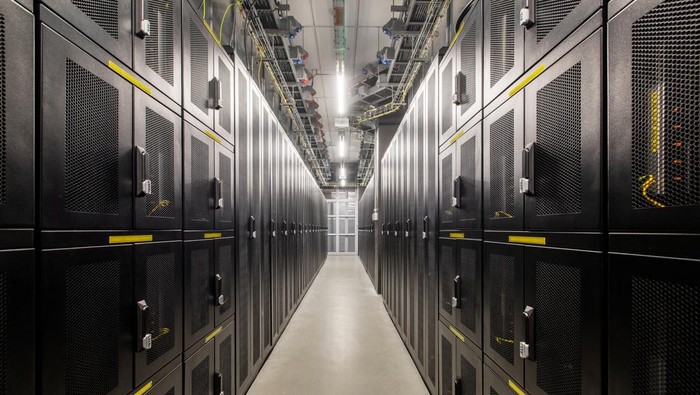
For the past decade, data centers have been synonymous with large, warehouse-like facilities that consume massive amounts of energy. Nvidia CEO Jensen Huang even referred to them as AI factories, emphasizing their role as the backbone of the machine learning-based economy, as quoted by detikINET from Techspot, Monday (January 19, 2026).
Now, some industry players are beginning to question whether data centers need to be so large. The emergence of micro data centers and edge data centers presents a new approach, with small computing devices that can be placed close to users, even in public or residential spaces.
In Devon, England, a company called Deep Green is attracting attention after utilizing waste heat from a data center the size of a washing machine to heat a public swimming pool. Deep Green’s founder, Mark Bjornsgaard, calls this approach the direction of the future. He believes public buildings have the potential to become locations for interconnected mini data centers that share workloads while utilizing waste heat.
Similar experiments are also beginning to enter the private sphere. In late 2025, a British couple revealed that a small server in their garden shed was being used to heat their home. Shortly thereafter, a university professor revealed that the AI GPU under his desk now doubles as a space heater.
While hyperscalers like Amazon, Google, and Microsoft continue to pour billions of dollars into building giant data centers, telecommunications analyst Benedict Evans believes there is a significant opportunity for small, edge data centers located near population centers. This physical proximity is thought to reduce latency and improve the responsiveness of computationally intensive applications.
A similar view is shared by Amanda Brock, head of the advocacy group OpenUK. She believes the dominance of large data centers has the potential to fade over time. She believes that abandoned urban spaces such as empty buildings and closed shops could be transformed into small, interconnected data centers.
In the long term, Brock also predicts that data processing will increasingly shift to local devices, from mobile phones and set-top boxes to home routers. This shift aligns with the AI trend away from giant models and toward smaller, more specific models.
Hugging Face’s AI and climate lead, Dr. Sasha Luccioni, believes that custom-designed AI models run locally tend to be more efficient and require less computing power. He believes that the continued use of large data centers is becoming increasingly difficult to sustain from an environmental perspective.
From a security perspective, University of Surrey cybersecurity professor Alan Woodward believes that distributed systems pose a lower risk. Small data centers are considered less likely to be a single point of failure, unlike giant facilities that can have widespread impacts if disrupted.
In fact, the concept of future data centers is no longer limited to Earth. Ramon Space CEO Avi Shabtai calls space a new opportunity to build small, modular data centers in orbit. His company is currently developing technology to test this concept. This trend shows that amidst increasing computing needs, the industry is starting to seek more flexible, efficient, and sustainable approaches, with data centers not always having to be larger.
RELATED NEWS


ABOUT US